
Peel-and-Stick, Pre-Pasted, or Paste-the-Wall? Choose by Project
Wallpaper guides · Choosing materials
The pattern may be the same, but the work at the wall can be quite different. Choose the application method after checking your surface, your project and the instructions for the material you will actually order.
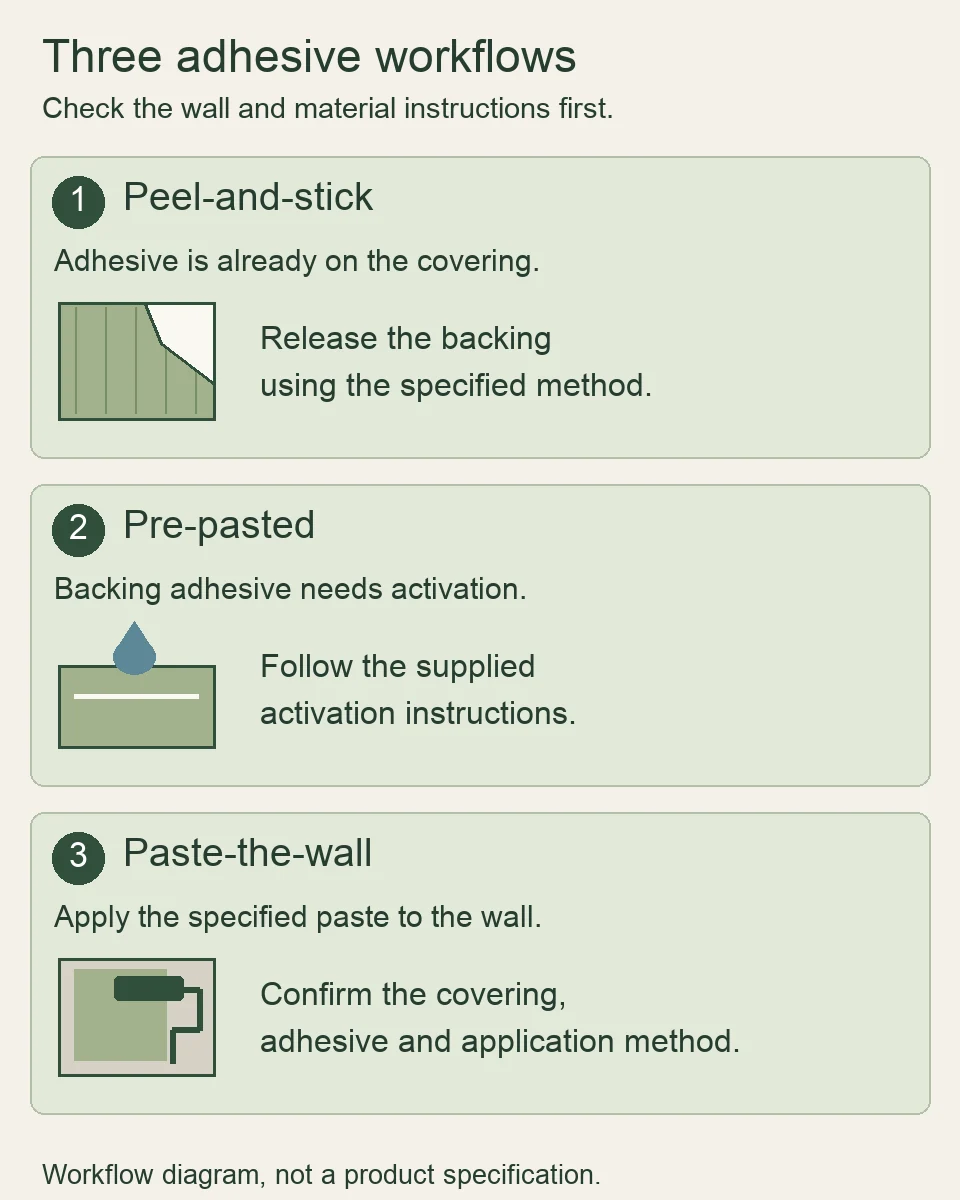
Compare what you will do, not just what the material is called.
“Peel-and-stick,” “pre-pasted” and “paste-the-wall” tell you something about the adhesive workflow. Terms such as fabric, paper and non-woven describe the covering itself. Keep those two questions separate when reading a product page: What is it made from? and How is this exact material applied?
| Method | What changes at installation | What to confirm first |
|---|---|---|
| Peel-and-stick | The adhesive is already on the covering, under a release liner. | Approved wall texture, paint finish and curing conditions; backing-release, seam and removal instructions. |
| Pre-pasted | The backing already has adhesive, but it needs the specified activation process. | Activation method and timing, any required resting or booking, and the hanging sequence for that product. |
| Paste-the-wall | The specified adhesive goes onto the prepared wall before the covering is hung. | That the covering is intended for this method, the compatible paste and primer, and the product’s working and seam instructions. |
Do not transfer a soaking time, seam method or paste recommendation from one product to another. Pre-pasted does not mean ready to hang straight from the package. Non-woven does not, by itself, tell you where to put adhesive. And a peel-and-stick label does not establish how often the covering can be repositioned.
What WallpaperDrop currently lists
Our material guide describes pre-pasted wallpaper, non-woven wallpaper requiring suitable paste, and peel-and-stick fabric with a self-adhesive backing. Check the options on your chosen product page and obtain the relevant instructions before deciding. Confirm the adhesive application method for the selected non-woven option rather than assuming it from the name.
A simpler workflow cannot rescue an unsuitable wall.
Before comparing convenience, identify the surface you are decorating. Is it smooth finished drywall, painted plaster, paneling or something else? Record the paint finish and any recent painting or repairs. Look for loose coatings, texture and unresolved moisture. A wall that needs attention still needs attention when the wallpaper arrives with adhesive already on it.
For example, if the wall has noticeable texture, the decision is not automatically “use paste instead.” First ask whether that substrate and texture are approved for the exact covering and adhesive system. If the paint is new, use the paint manufacturer’s curing directions alongside the wallpaper requirements. Do not choose a universal waiting period from an unrelated project.
Work through the wall-preparation checklist before ordering. If you cannot identify the wall finish or explain an area of damage, gather photographs and ask for advice before cutting panels or applying adhesive.
Compare the whole project, including the day you take it down.
Installation is only one part of the decision. Ask how the actual material should be cleaned, what happens if a panel is damaged and what its removal process involves. “Removable” does not guarantee that every paint finish will stay untouched. A rental project also needs permission from the owner or manager where required.
There is no reliable rule that peel-and-stick is always easiest, or that pasted wallpaper always lasts longer. Your wall, the selected system, room conditions and the installer’s experience matter. If you are hiring someone, send them the material instructions and wall photographs before requesting a quote. A quote based only on square footage can miss preparation or access work.
Separate the costs in your notes: covering, approved adhesive or activation supplies, preparation, tools and installation labor. Use the same wall and design when comparing options. A cheaper material price alone does not establish a cheaper finished project.
Use the worksheet to find your next check.
Choose the workflow you are considering and record what you know about the wall. This tool does not score materials or approve a surface. It helps you leave with specific questions instead of an automatic “best wallpaper” recommendation. Your selections stay in this page and reset when it is reloaded.
Your material-choice record
Ask these questions before you approve the order.
- Which exact material am I selecting? Keep its full name with the design and wall measurements. A room photograph does not identify the backing or adhesive.
- Is my wall and paint finish approved? Describe the actual texture, coating, recent work and room conditions.
- What preparation and application instructions apply? Ask about primer, paste or activation only as relevant to that material. Check seams and trimming too.
- What will a sample tell me? Confirm what it represents: artwork color, print scale, texture or a specified surface trial. Those are different questions.
- What care and removal instructions come with it? Keep them with the order rather than relying on a generic removable-wallpaper claim.
A physical sample helps you compare the design with your trim, floor and furnishings. If a surface trial is required, follow the supplier’s process; simply holding a sample against a wall is a color check, not an adhesion test. Likewise, a successful observation does not replace the material’s stated compatibility requirements.
Choose the material first, then plan the installation.
Once the wall and material are confirmed, record the full wall dimensions and openings. Keep the largest width and height for each wall, with units. Wall area alone is not an order quantity; matching, format and trimming requirements still matter.
If you choose self-adhesive fabric, the first-panel planning guide explains the alignment decisions to make before starting. For the wider project, use our installation preparation checklist alongside the instructions supplied with the selected material.